
A Future Beyond Labour
What waits on the other side if labour is automated and we are free?

“It is a society of laborers which is about to be liberated from the fetters of labor, and this society does no longer know of those other higher and more meaningful activities for the sake of which this freedom would deserve to be won.” - Hannah Arendt
What would you do tomorrow if you didn’t have to work? Not just take a break, but never work again. What would you do with your days?
I have been pondering this question for a while and wanted to pour my thoughts down to help myself understand my relationship to - and the value of - labour. Today, a potential application of AI (perhaps the ultimate goal for some) is that it will “liberate” us from work. But do we really know what kind of freedom we want and what we would do with it? A few obvious things come to mind, such as travel, time with family, a neglected hobby. But beyond these ideas, the future feels uncertain.
Specifically because we already see Generative AI increasingly replacing jobs. Increasingly, the jobs under threat are ones that I think inherently require that “human touch”: graphic designers, writers, programmers, researchers.
My central question that I want to explore in the scope of this blog would then follow: if AI automates labour away, what do we get on the other side?
To answer this question, I turned to Hannah Arendt’s “Human Condition”. Here, she makes the distinction between Labour, Work and Action. An oversimplified version of her distinction is as follows.
Labour is the activity which corresponds to the necessities of human existence. These are the activities that one does to maintain life. Labour activities are distinguished by their never-ending character. They do not produce any results beyond the maintenance of life.
A simple example would be cooking and washing dishes - repetitive work that never ends for as long as we live. Another example that is relevant to our questions at hand is garment workers in fast-fashion factories sewing the same seams for hours on end, producing clothes that are cheaply made, quickly bought, and rapidly discarded.
Work for Arendt is a process that culminates in an outcome; something that produces more value beyond survival. Work has a beginning and an end.
An example of work could be that of a carpenter, a researcher, an artist. They put work into creating pieces that are not necessary for survival and take effort and time to create. There is craftsmanship involved, and the outcome can outlast the creator and the consumer.
Action on the other hand is the activity where people appear before one another, speak and initiate something new. They shape a shared world together. Action is strictly the realm of plurality, people as equals in a shared public space, speech being the primary medium. She believes this is where freedom expresses itself the most, and finds action to be the most valuable form of activity.
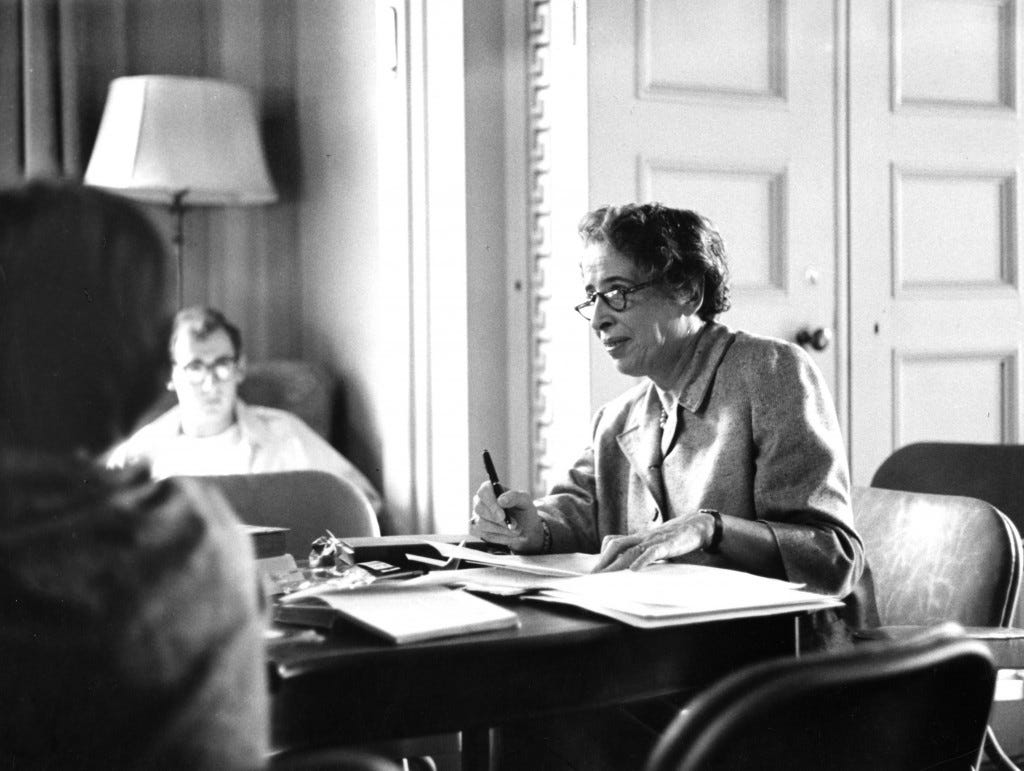
What Arendt observed was that work collapsed into labour. Even though Arendt did not consider Work more freeing than Labour, in this present day, I do. My interpretation is that this occurs because capitalism favours the disposable. Artists and craftsmen are forced to be changed into labourers, creating temporary and disposable items in a never-ending cycle of production. The carpenter that would work on a single table with care and creativity is now replaced by assembly line workers who churn out many identical tables quickly. Work is stripped of its depth, its craftsmanship and its permanence.
What I fear though is that we now live in a day and age where our lives are defined by labour, that is, people see themselves as “job-holders” and start to consider non-paid activities as hobbies that are optional. Action (and even Work) are things we now do on the margins of our labour-oriented life. Therefore, what waits for us if the one thing we tie so closely to our identity becomes automated?
Given that labour is the repetitive grind of survival and work is the crafted, durable output that outlasts both creator and consumer, what do we actually get on the other side when AI automates labour away?
The optimistic answer to my central question is time. In terms of Arendt, that would be time for work, making things that outlast us with craftsmanship and depth. And most importantly, time for action, for the creative, collective and political life that she thought was most distinctly human.
However, much of what AI is automating right now, as mentioned above, isn’t labour at all. AI automation threatens both work and action. Writing, designing, political engagement (writing speeches and making AI agents debate). AI automation is striking what Arendt considers to be most distinctly human.
What we get on the other side ultimately depends on which of the three activities is automated. If we find a way to protect work and action by deciding that there are domains of human activity that should remain human (not because machines can’t do them but because doing the activity matters as much as the outputs for humans), then automation of labour could genuinely be liberating. People freed from the turmoil of repetitive unfulfilling work would have access to activities that make human life feel meaningful. But if we continue to the seeming trajectory of AI development, then we are faced with a potential nightmare. Stripped away of activities that make us human, while AI creates, socializes and writes poetry.
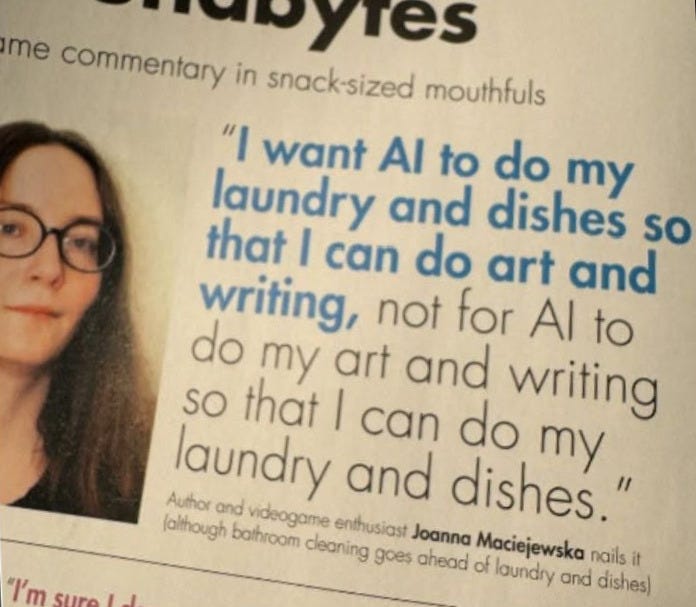
I’d love to hear what you think. Particularly whether you see any way to protect work and action in the face of automation, or whether you think the optimistic scenario is still possible. The comment section is, fittingly, a small act of action.
Brilliant read! Indeed it does appear that AI is crusading a charge for the converting away of work and action into labour.
Yet still, I’d argue almost to the contrary; insofar as AI remain predicting and not living, true work, and its creative precondition, will always exist. Just because there exist paintings in airports and motels doesn’t mean the craft of painting is lost forever, in much the same way that AI-generated text lacks the lived substance of an author’s pages despite its apparent ‘cognitive superiority’. Work, and action, can always exist. I’d push back and say that, if anything, the increasing sameness that will inevitably result from AI invading most of the words we read, songs we hear, or chairs we sit on will drive a demand in the exact opposite direction, for something novel and imperfect and refreshingly human.
excellent observation and conclusion